
Automated Occupancy Monitoring
The client required a fully automated system capable of detecting seat occupancy without manual observation. The solution needed to distinguish occupied and vacant seats accurately, even during peak hours, to streamline floor operations.
Real-Time Insight Delivery
A central dashboard was requested to display occupancy data, turnover metrics, and customer flow trends in real time. The client needed visibility into peak hours and slow-moving zones to improve service responsiveness.
Seamless Workflow Integration
The system was expected to integrate into existing operational processes without disrupting restaurant flow. The client wanted a non-intrusive model that could be deployed with minimal hardware adjustments and training efforts.

Manual observation resulted in incorrect occupancy records, especially during rush hours. Staff often relied on assumptions, creating inefficiencies that affected customer wait times and table allocation accuracy.

The restaurant had no structured mechanism to understand how customers moved through the dining areas. This lack of visibility impacted manpower distribution, making it difficult to prepare for busy periods.

Table clearing and preparation timings were based on guesswork. Without accurate turnover data, many tables remained underutilized despite available seating capacity.

Existing systems provided no heatmaps or hourly patterns of customer behavior. Managers were unable to optimize seating layouts, predict demand, or align operations with actual real-time insights.
AI-powered Seat Detection System
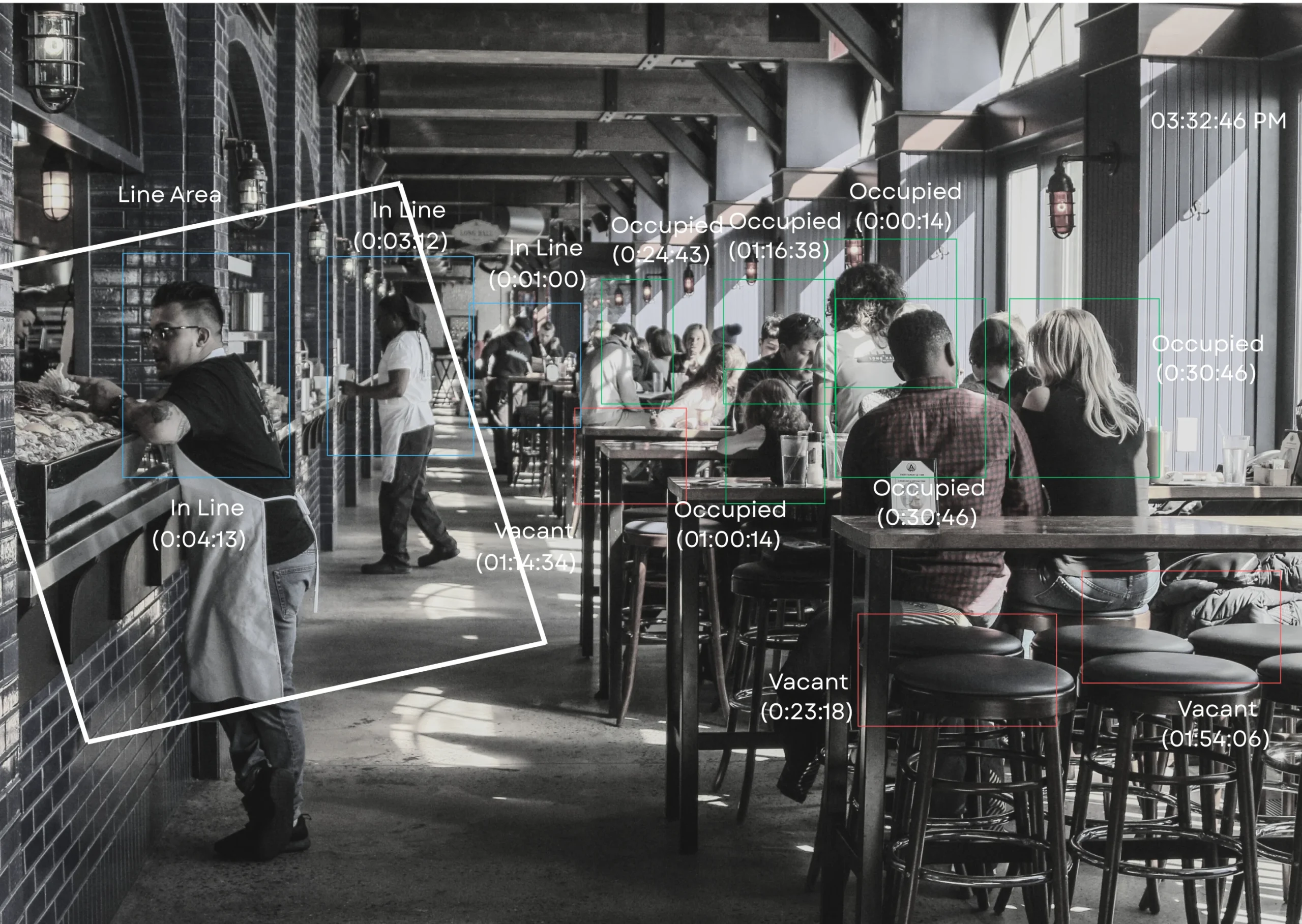
A YOLO-based computer vision model was implemented to automatically categorize seats as occupied or vacant. High-accuracy frame-by-frame analysis was achieved through overhead cameras and Python-based processing pipelines.
Real-time Processing Pipelines
Continuous video streams were connected to a backend workflow built in Python and OpenCV. Real-time data packets were generated and transmitted to the analytics engine, enabling uninterrupted seat monitoring.
Dynamic Heatmap Engine
A customer movement tracking module was delivered, where hourly heatmaps were produced using AI Agents. These visual insights allowed managers to observe movement density, entry/exit patterns, and zone congestion.
Centralized Analytics Dashboard
A unified dashboard was developed to display occupancy trends, turnover time, high-traffic sections, and predictive flow insights. The dashboard was integrated with the AI pipeline for live updates and easy operational decision-making.


Our client is a renowned restaurant owner with multiple branches in Malta, Europe. They were seeking solutions to modernize their in-restaurant operations so that they can trace occupied and empty seats, compute table occupancy, and generate heat maps that display real-time motion.
An impressive AI system was deployed that changed how we manage seating operations. Accurate insights, automation, and smooth integration helped our team operate far more effectively.
An intelligent AI seat occupancy system has entirely changed the way the restaurant was running—be it the table for management, staff management, or tracking customer flow. The inconvenience of manual tracking is replaced, and as an AI user, you receive both real-time and dependable information on all that by pressing a button.
Computer vision, automation, and dynamic heatmaps helped the managers make decisions quickly, enhance customer experience, and simply expand to any place. Overall, it demonstrates that a small smart AI can accelerate the processes, minimize the errors, and develop a strong and future-proof hospitality system.
Get in touch to discover tailored strategies that move your business forward.
Get in touch with our certified consultants and experts to explore innovative solutions and services. We’ve empowered companies across various domains to transform their business capabilities and achieve their strategic goals.