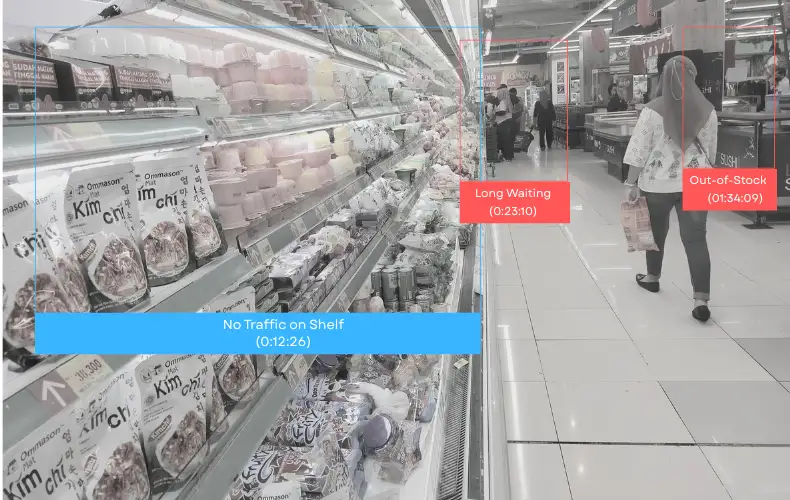

Enhancing Retail Operations with AI-Based Queue & Shelf Monitoring

An AI-based monitoring system was implemented for a Retail outlet to track the queues, customers’ dwell time, and shelf interactions in real time.
Customer
Commercial Retail Outlet
Country / Region
Italy
Industry
Retail
Enhancing Retail Operations with AI-Based Queue & Shelf Monitoring Banner Case Study

Highlights

Real-time Queue Tracking
Smart Shelf Interaction Analysis
Automated Traffic Jams Alerts
Live Operational Dashboard
Client Requirements

Need for Queue Visibility

The client had to have a reliable system that would constantly check the formation of the queue, detect an increase in the waiting time, and send immediate alerts that would help reduce delays during the high customer traffic periods.

Shelf Interaction Knowledge

The engagement and the dwell time of products, along with the interaction of customers with shelves, needed to be in a fine outline so as to enhance product placement, layout strategy and the avoidance of unexposed stock-outs.

Real-time Notifications & Control

The managers asked about a single dashboard and automated alerting system that would be able to promptly detect congestion, stock-related problems, and strange customer movement trends without the involvement of manual supervision.

Challenges

Unpredictable Queues Build-up

The queue length changed all day and, in most cases, tended to increase without any notice. In the absence of automated monitoring, employees had a hard time keeping up, and hence, there was a lack of consistency in the speed of service and frustration of customers during peak hours.

Lack of Real-Time Data

The decision on staffing was made based on assumptions rather than actual conditions in the stores. Lack of real-time pointers meant that redistribution of staff was not done in time when the crowd suddenly occurred or when the shelves were busy.

Lack of Shelf Behavior Understanding

The interaction of the customers with the shelves could not be easily monitored. This limited the capability to learn product interest and layout effectiveness, as well as low stock situations were discovered before they affected availability.

Disjointed Manual Monitoring Processes

Monitoring was being done manually, which created delays and incomplete understanding. An automated system that could have consolidated congestion of data, alerts, and customer behavior analytics required a centralized system.

After Challenge - Enhancing Retail Operations with AI-Based Queue & Shelf Monitoring
Solutions

Queues Length Detection by AI

An automatic queue length measuring and a noticeable increase in congestion identifying YOLO-powered detection pipeline were introduced. They were fitted with tracking algorithms to track the movement of customers and alert thresholds installed to alert the staff to the shop when waiting time had breached an acceptable limit.

Shelf Interaction/Dwell Time monitoring

To track customer dwell, a shelf analytics module that utilizes pose estimation and object tracking was implemented to track customer behavior. The system also tracked the patterns of product interaction and provided actionable information to make the shelf layout better and replace the fast-moving products in an efficient way.

Automated Stock alerts and congestion alerts

Rules that were run by AI were established to indicate crowded aisles, unusual activity behavior, and likely stock shortage. Live messages were delivered to the management of the stores, as well as timely responses and reduced disruption of the flow of customers.

Unified Operational Dashboard

A real-time video analytics and WebSocket streaming dashboard based on Python was provided. All the measures, such as the queue length, dwell time, alerts, and camera feeds, were consolidated, which allowed the managers to make efficient and timely operational choices.

Getting prepared to make your retail activity real-time AI visible? Let us develop your smart system for retail operational flow.
Technical Architecture
Key Features
Technical Stack
COMPANY

The client runs a medium-sized retail outlet that has a wide range of clients visiting on a daily basis. Their attention increasingly shifted towards enhancing operational effectiveness and the visibility of products. Their team wanted to find new technologies that would allow them to get real-time data on in-store behavior and performance measurements.

The artificial intelligence system provided real-time customer movement and shelf behavior. The way our store’s operations would take place was greatly improved, and its speed and accuracy significantly increased, resulting in improved customer service and efficiency.

Conclusion

The AI-based monitoring system made operations much more efficient, as it gave real-time insights into customer behavior, shelf engagement, and queue behavior. Decision-making was also smoother and more efficient due to automated alerts and a centralized dashboard, which makes the in-store experience more efficient and quicker.

Benefits
  • Live monitoring enhanced the queue management.
  • Shelf engagement data was used to improve product positioning.
  • Automated notifications minimized time wastage.
  • The store layout is optimized in terms of customer movement.

Build Your Solution With Us

Get in touch to discover tailored strategies that move your business forward.

connect@melonleaf.com

Please enter your business email

Speak With Our Team About Your Next Move

Get in touch with our certified consultants and experts to explore innovative solutions and services. We’ve empowered companies across various domains to transform their business capabilities and achieve their strategic goals.

Latest Case Studies

Send an Email
To : connect@melonleaf.com